
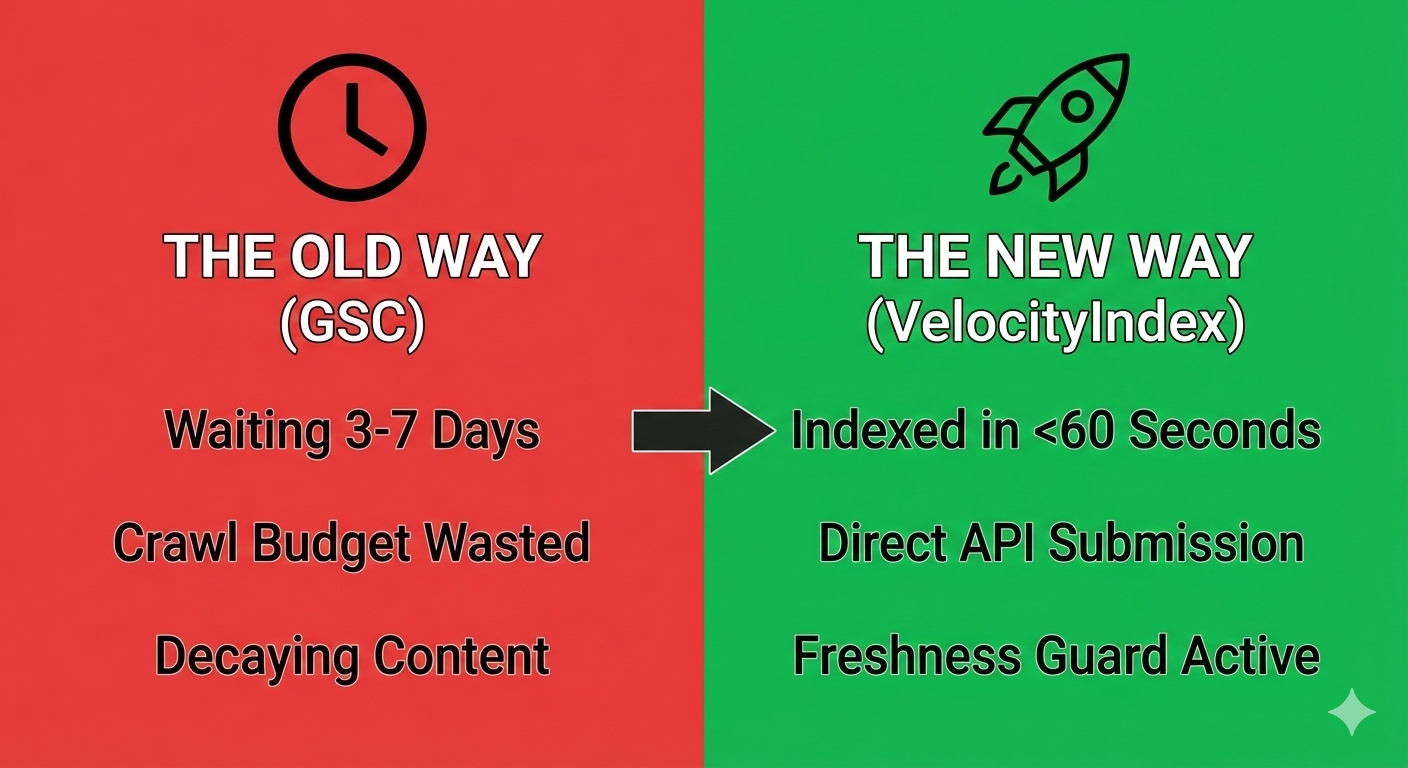
Instant indexing means telling search engines about your new or updated URLs directly, instead of waiting for their crawlers to discover the changes on their own. VelocityIndex automates instant indexing so your pages enter the discovery pipeline the moment they go live.
How Instant Indexing Works
Modern search engines accept direct URL notifications through official channels — most notably the IndexNow protocol, supported by Bing, Yandex, Naver and Seznam — alongside each engine’s own submission APIs. VelocityIndex submits your URLs through these channels, then records the response per engine.
What VelocityIndex Does for Instant Indexing
- Automatic submission — the WordPress plugin submits new and updated posts the moment you publish them.
- API submission — push URLs programmatically through the REST API from any platform.
- AI pre-analysis — each URL is checked for common indexing blockers before it is submitted.
- Status tracking — see instant indexing results per engine in your dashboard history.
An Honest Note on Instant Indexing Speed
Submission gets your URL in front of search engines fast — typically within minutes. Whether and when a page is actually indexed is decided by each search engine on its own. Instant indexing removes the discovery delay; it does not guarantee indexing outcomes.
Start instant indexing today via the WordPress plugin, the REST API, or read how the protocol works at indexnow.org.
Setting Up Automated Submission
With VelocityIndex this takes minutes to activate. Install the WordPress plugin or connect through the API, and new or updated URLs are submitted to supported engines as they publish — no manual requests per URL. The dashboard then shows each URL’s submission and indexing status so the workflow becomes a measurable part of your publishing pipeline rather than a hope.
Which Engines Support It
Coverage differs per engine. IndexNow-compatible engines accept near-real-time URL notifications, while others pick up submitted URLs on their own crawl schedule. VelocityIndex submits through every channel each engine supports and reports the observed outcome per engine — see the integrations page for the current coverage list.
Fitting It Into Your Publishing Workflow
The real value shows up on a schedule: product pages that must rank before a launch, news posts with a short relevance window, and documentation updates that users search for immediately. In each case, automated submission replaces the “publish and wait” gap with a submission event you can point to in your reports.
For teams already publishing through WordPress, the plugin requires no workflow change — the plugin submits on publish and update events automatically. API-driven teams trigger the same pipeline from their own tooling, which keeps the pipeline consistent whether a URL came from a CMS, a static generator, or a custom backend.
Measuring the Results
Speed only counts if you can verify it. VelocityIndex logs each submission and the observed index status per engine, so you can compare pre- and post-automation indexing times on your own URLs. That measurement loop — submit, observe, report — is what turns instant indexing from a promise into an operational metric.
Getting Started
Ready to try it on your own URLs? Create an account, connect your site, and watch the first submissions land within minutes. The pricing plans include every engine integration — no per-engine add-ons.
Common Questions About Speed
How fast is “instant”? Engines that accept push notifications can pick up a URL within minutes; others take longer regardless of submission method. What changes with automation is that the submission happens at publish time — every time — and that you get a recorded status instead of a guess.
Because submission status is tracked per engine, you also see which engines respond fastest for your site type — useful context when deciding where to concentrate promotion effort after a launch.